If I ask you to find the exact pricing terms you gave a specific client two years ago, or the safety compliance clause in a 40-page PDF contract from last month, how long would it take you?
For most business owners, the answer involves opening Google Drive, clicking through nested folders, searching a few keywords, opening three different PDFs, and finally hitting Ctrl+F until they find it.
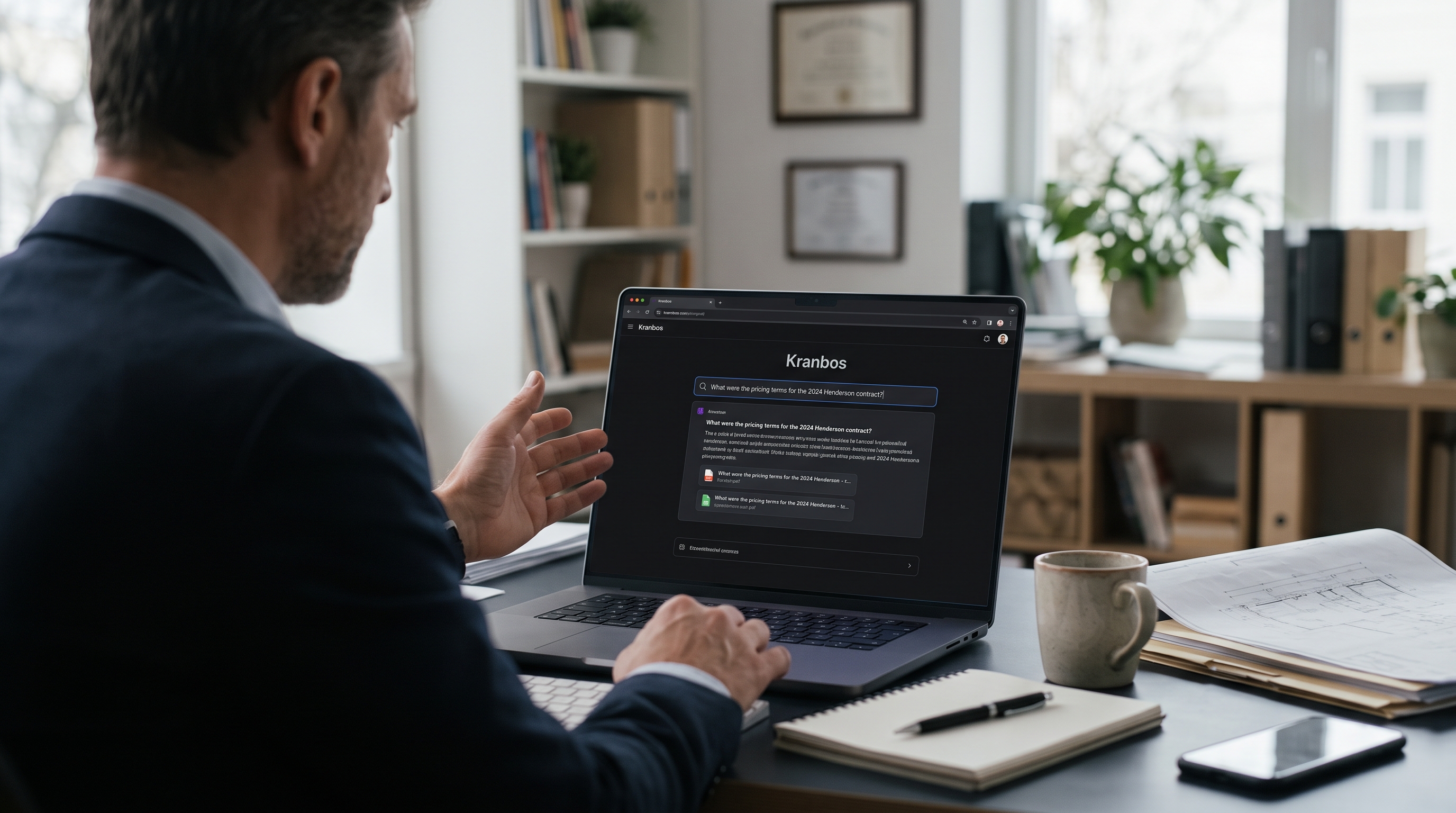
Your company probably doesn't have a storage problem. You have a retrieval problem.
The difference between storing data and using it
Cloud storage (like Google Drive or Dropbox) is designed to hold files. It is not designed to understand the context of what is inside those files.
When your team needs to reference past work—whether it’s a legal precedent, a past construction quote, or specific project specs—they have to rely on their own memory to know which file to open. If the person who created the file leaves the company, that institutional knowledge leaves with them.
Enter the private internal search engine
This is one of the most immediate ways we use custom AI to speed up operations. Instead of manually digging through folders, we build a private search interface that connects directly to your existing files.
Here is how it changes the workflow:
| The Old Way (Ctrl+F) | The Kranbos Way (Custom Build) |
|---|---|
| Search by filename ("Project_Specs_V3.pdf") | Search by question ("What was the HVAC budget for the Smith project?") |
| Skim 40 pages to find the right paragraph | A direct answer with its source |
| Hope the data is current | Verified sourcing (AI links exactly to the page it pulled the answer from) |
| Digging through folders | One question, one sourced answer |
Secure by design
Chat tools like ChatGPT are great with a few files at a time. They aren't built to search your whole client history, and uploading files one chat at a time doesn't scale. You'd also want control over who can see what.
That's why an internal search engine works best as a custom Build in an isolated environment for your company. The AI only indexes your verified documents, and the data is not used to train public models. It acts as a secure, private librarian for your company's proprietary knowledge.
If your team is losing hours a week just looking for things they know they already have, it might be time to stop relying on folder structures and start building a smart internal database. Start with a free 20-minute call, and let's see where your team's time goes. You can also read more about internal tools.